


Latest [Feb 04, 2022] DP-300 Exam with Accurate Administering Relational Databases on Microsoft Azure PDF Questions
Take a Leap Forward in Your Career by Earning Microsoft 178 Questions
Optimize and Monitor Operational Resources: 15-20%
- Implement Performance-Related Maintenance Functions: This objective covers the learners’ skills in managing storage capacity, configuring database auto-tuning, and implementing index & statistics maintenance functions.
- Configure the User Database for Maximum Performance: The students should be able to configure IQP, compute resources, and implement database-scoped configuration.
- Determine Performance-Related Concerns: The applicants need to possess competence in identifying sessions causing blocking, evaluating fragmentation/growth of logs and database, as well as evaluating the parameters for the configuration of a performance-related database.
- Configure Resources for Maximum Performance: This module requires your skills in configuring Resource Governors, storage & infrastructure resources, as well as service & server account settings.
- Monitor Performance & Activity: The examinees must have competence in interpreting performance metrics, preparing performance baseline operations, and establishing performance metrics sources, among others.
NEW QUESTION 77
HOTSPOT
You have an Azure SQL Database managed instance named sqldbmi1 that contains a database name Sales.
You need to initiate a backup of Sales.
How should you complete the Transact-SQL statement? To answer, select the appropriate options in the answer area.
NOTE: Each correct selection is worth one point.
Hot Area:
Answer:
Explanation:
Explanation:
Box 1: TO URL = 'https://storage1.blob.core.windows.net/blob1/Sales.bak' Native database backup in Azure SQL Managed Instance.
You can backup any database using standard BACKUP T-SQL command:
BACKUP DATABASE tpcc2501
TO URL = 'https://myacc.blob.core.windows.net/testcontainer/tpcc2501.bak' WITH COPY_ONLY Box 2: WITH COPY_ONLY Reference:
https://techcommunity.microsoft.com/t5/azure-sql-database/native-database-backup-in-azure-sql-managed- instance/ba-p/386154
NEW QUESTION 78
What should you do after a failover of SalesSQLDb1 to ensure that the database remains accessible to SalesSQLDb1App1?
- A. Configure SalesSQLDb1 as writable.
- B. Update the connection strings of SalesSQLDb1App1.
- C. Update the users in SalesSQLDb1.
- D. Update the firewall rules of SalesSQLDb1.
Answer: D
Explanation:
Scenario: SalesSQLDb1 uses database firewall rules and contained database users.
This is a case study. Case studies are not timed separately. You can use as much exam time as you would like to complete each case. However, there may be additional case studies and sections on this exam. You must manage your time to ensure that you are able to complete all questions included on this exam in the time provided.
To answer the questions included in a case study, you will need to reference information that is provided in the case study. Case studies might contain exhibits and other resources that provide more information about the scenario that is described in the case study. Each question is independent of the other questions in this case study.
At the end of this case study, a review screen will appear. This screen allows you to review your answers and to make changes before you move to the next section of the exam. After you begin a new section, you cannot return to this section.
To start the case study
To display the first question in this case study, click the Next button.
Use the buttons in the left pane to explore the content of the case study before you answer the questions.
Clicking these buttons displays information such as business requirements, existing environment, and problem statements.
If the case study has an All Information tab, note that the information displayed is identical to the information displayed on the subsequent tabs.
When you are ready to answer a question, click the Question button to return to the question.
Overview
Topic 3, ADatum Corporation
Existing Environment
ADatum has one database server that has Microsoft SQL Server 2016 installed. The server hosts three mission-critical databases named SALESDB, DOCDB, and REPORTINGDB.
SALESDB collects data from the stores and the website.
DOCDB stores documents that connect to the sales data in SALESDB. The documents are stored in two different JSON formats based on the sales channel.
REPORTINGDB stores reporting data and contains several columnstore indexes. A daily process creates reporting data in REPORTINGDB from the data in SALESDB. The process is implemented as a SQL Server Integration Services (SSIS) package that runs a stored procedure from SALESDB.
Requirements
Planned Changes
ADatum plans to move the current data infrastructure to Azure. The new infrastructure has the following requirements:
Migrate SALESDB and REPORTINGDB to an Azure SQL database.
Migrate DOCDB to Azure Cosmos DB.
The sales data, including the documents in JSON format, must be gathered as it arrives and analyzed online by using Azure Stream Analytics. The analytics process will perform aggregations that must be done continuously, without gaps, and without overlapping.
As they arrive, all the sales documents in JSON format must be transformed into one consistent format.
Azure Data Factory will replace the SSIS process of copying the data from SALESDB to REPORTINGDB.
Technical Requirements
The new Azure data infrastructure must meet the following technical requirements:
Data in SALESDB must encrypted by using Transparent Data Encryption (TDE). The encryption must use your own key.
SALESDB must be restorable to any given minute within the past three weeks.
Real-time processing must be monitored to ensure that workloads are sized properly based on actual usage patterns.
Missing indexes must be created automatically for REPORTINGDB.
Disk IO, CPU, and memory usage must be monitored for SALESDB.
NEW QUESTION 79
From a website analytics system, you receive data extracts about user interactions such as downloads, link clicks, form submissions, and video plays.
The data contains the following columns:
You need to design a star schema to support analytical queries of the dat a. The star schema will contain four tables including a date dimension.
To which table should you add each column? To answer, select the appropriate options in the answer area.
NOTE: Each correct selection is worth one point.
Answer:
Explanation: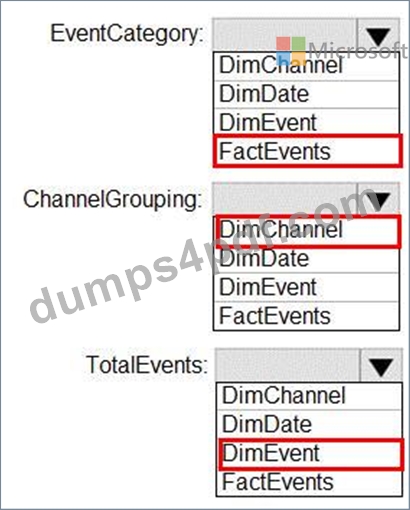
Reference:
https://docs.microsoft.com/en-us/power-bi/guidance/star-schema
NEW QUESTION 80
You have SQL Server 2019 on an Azure virtual machine that runs Windows Server 2019. The virtual machine
has 4 vCPUs and 28 GB of memory.
You scale up the virtual machine to 16 vCPUSs and 64 GB of memory.
You need to provide the lowest latency for tempdb.
What is the total number of data files that tempdb should contain?
- A. 0
- B. 1
- C. 2
- D. 3
Answer: D
Explanation:
Section: [none]
Explanation:
The number of files depends on the number of (logical) processors on the machine. As a general rule, if the
number of logical processors is less than or equal to eight, use the same number of data files as logical
processors. If the number of logical processors is greater than eight, use eight data files and then if contention
continues, increase the number of data files by multiples of 4 until the contention is reduced to acceptable
levels or make changes to the workload/code.
Reference:
https://docs.microsoft.com/en-us/sql/relational-databases/databases/tempdb-database
NEW QUESTION 81
Note: This question is part of a series of questions that present the same scenario. Each question in the series contains a unique solution that might meet the stated goals. Some question sets might have more than one correct solution, while others might not have a correct solution.
After you answer a question in this section, you will NOT be able to return to it. As a result, these questions will not appear in the review screen.
You have an Azure SQL database named Sales.
You need to implement disaster recovery for Sales to meet the following requirements:
During normal operations, provide at least two readable copies of Sales.
Ensure that Sales remains available if a datacenter fails.
Solution: You deploy an Azure SQL database that uses the Business Critical service tier and Availability Zones.
Does this meet the goal?
- A. Yes
- B. No
Answer: A
Explanation:
Premium and Business Critical service tiers leverage the Premium availability model, which integrates compute resources (sqlservr.exe process) and storage (locally attached SSD) on a single node. High availability is achieved by replicating both compute and storage to additional nodes creating a three to four-node cluster.
By default, the cluster of nodes for the premium availability model is created in the same datacenter. With the introduction of Azure Availability Zones, SQL Database can place different replicas of the Business Critical database to different availability zones in the same region. To eliminate a single point of failure, the control ring is also duplicated across multiple zones as three gateway rings (GW).
Reference:
https://docs.microsoft.com/en-us/azure/azure-sql/database/high-availability-sla
NEW QUESTION 82
A data engineer creates a table to store employee information for a new application. All employee names are in the US English alphabet. All addresses are locations in the United States. The data engineer uses the following statement to create the table.
You need to recommend changes to the data types to reduce storage and improve performance.
Which two actions should you recommend? Each correct answer presents part of the solution.
NOTE: Each correct selection is worth one point.
- A. Change Salaryto the moneydata type.
- B. Change PhoneNumberto the bigintdata type.
- C. Change PhoneNumberto the floatdata type.
- D. Change LastHireDateto the datedata type.
- E. Change LastHireDate to the datetime2(7)data type.
Answer: A,D
NEW QUESTION 83
You are evaluating the business goals.
Which feature should you use to provide customers with the required level of access based on their service agreement?
- A. Conditional Access in Azure
- B. row-level security (RLS)
- C. dynamic data masking
- D. service principals
Answer: B
Explanation:
Reference:
https://docs.microsoft.com/en-us/sql/relational-databases/security/row-level-security?view=sql-server-ver15
NEW QUESTION 84
You receive numerous alerts from Azure Monitor for an Azure SQL database.
You need to reduce the number of alerts. You must only receive alerts if there is a significant change in usage patterns for an extended period.
Which two actions should you perform? Each correct answer presents part of the solution.
NOTE: Each correct selection is worth one point.
- A. Set Threshold Sensitivity to Low
- B. Set the Alert logic threshold to Dynamic
- C. Set Force Plan to On
- D. Set Threshold Sensitivity to High
- E. Set the Alert logic threshold to Static
Answer: A,B
Explanation:
B: Dynamic Thresholds continuously learns the data of the metric series and tries to model it using a set of algorithms and methods. It detects patterns in the data such as seasonality (Hourly / Daily / Weekly), and is able to handle noisy metrics (such as machine CPU or memory) as well as metrics with low dispersion (such as availability and error rate).
D: Alert threshold sensitivity is a high-level concept that controls the amount of deviation from metric behavior required to trigger an alert.
Low - The thresholds will be loose with more distance from metric series pattern. An alert rule will only trigger on large deviations, resulting in fewer alerts.
Incorrect Answers:
A: High - The thresholds will be tight and close to the metric series pattern. An alert rule will be triggered on the smallest deviation, resulting in more alerts.
Reference:
https://docs.microsoft.com/en-us/azure/azure-monitor/platform/alerts-dynamic-thresholds
NEW QUESTION 85
You have an Azure Data Lake Storage Gen2 container.
Data is ingested into the container, and then transformed by a data integration application. The data is NOT modified after that. Users can read files in the container but cannot modify the files.
You need to design a data archiving solution that meets the following requirements:
New data is accessed frequently and must be available as quickly as possible.
Data that is older than five years is accessed infrequently but must be available within one second when requested.
Data that us older than seven years is NOT accessed. After seven years, the data must be persisted at the lowest cost possible.
Costs must be minimized while maintaining the required availability.
How should you manage the data? To answer, select the appropriate options in the answer area.
NOTE: Each correct selection is worth one point.
Answer:
Explanation:
Reference:
https://docs.microsoft.com/en-us/azure/storage/blobs/storage-blob-storage-tiers
NEW QUESTION 86
You have 20 Azure SQL databases provisioned by using the vCore purchasing model.
You plan to create an Azure SQL Database elastic pool and add the 20 databases.
Which three metrics should you use to size the elastic pool to meet the demands of your workload? Each correct answer presents part of the solution.
NOTE: Each correct selection is worth one point.
- A. total number of databases * average CPU utilization per database
- B. maximum number of concurrent sessions for all the databases
- C. number of concurrently peaking databases * peak CPU utilization per database
- D. geo-replication support
- E. total size of all the databases
Answer: A,C,E
Explanation:
Explanation
Explanation:
CE: Estimate the vCores needed for the pool as follows:
For vCore-based purchasing model: MAX(<Total number of DBs X average vCore utilization per DB>,<Number of concurrently peaking DBs X Peak vCore utilization per DB)
A: Estimate the storage space needed for the pool by adding the number of bytes needed for all the databases in the pool.
Reference:
https://docs.microsoft.com/en-us/azure/azure-sql/database/elastic-pool-overview
NEW QUESTION 87
DRAG DROP
You have SQL Server 2019 on an Azure virtual machine that contains an SSISDB database.
A recent failure causes the master database to be lost.
You discover that all Microsoft SQL Server integration Services (SSIS) packages fail to run on the virtual machine.
Which four actions should you perform in sequence to resolve the issue? To answer, move the appropriate actions from the list of actions to the answer area and arrange them in the correct.
Select and Place:
Answer:
Explanation:
Section: [none]
Explanation:
Step 1: Attach the SSISDB database
Step 2: Turn on the TRUSTWORTHY property and the CLR property
If you are restoring the SSISDB database to an SQL Server instance where the SSISDB catalog was never created, enable common language runtime (clr) Step 3: Open the master key for the SSISDB database Restore the master key by this method if you have the original password that was used to create SSISDB.
open master key decryption by password = 'LS1Setup!' --'Password used when creating SSISDB' Alter Master Key Add encryption by Service Master Key Step 4: Encrypt a copy of the mater key by using the service master key Reference:
https://docs.microsoft.com/en-us/sql/integration-services/backup-restore-and-move-the-ssis-catalog
NEW QUESTION 88
DRAG DROP
You need to configure user authentication for the SERVER1 databases. The solution must meet the security and compliance requirements.
Which three actions should you perform in sequence? To answer, move the appropriate actions from the list of actions to the answer area and arrange them in the correct order.
Select and Place:
Answer:
Explanation:
Explanation:
Scenario: Authenticate database users by using Active Directory credentials.
The configuration steps include the following procedures to configure and use Azure Active Directory authentication.
1. Create and populate Azure AD.
2. Optional: Associate or change the active directory that is currently associated with your Azure Subscription.
3. Create an Azure Active Directory administrator. (Step 1)
4. Configure your client computers.
5. Create contained database users in your database mapped to Azure AD identities. (Step 2)
6. Connect to your database by using Azure AD identities. (Step 3)
Reference:
https://docs.microsoft.com/en-us/azure/azure-sql/database/authentication-aad-overview Implement a Secure Environment Question Set 2
NEW QUESTION 89
HOTSPOT
You are designing an enterprise data warehouse in Azure Synapse Analytics that will store website traffic analytics in a star schema.
You plan to have a fact table for website visits. The table will be approximately 5 GB.
You need to recommend which distribution type and index type to use for the table. The solution must provide the fastest query performance.
What should you recommend? To answer, select the appropriate options in the answer area.
NOTE: Each correct selection is worth one point.
Hot Area:
Answer:
Explanation:
Section: [none]
Explanation:
Box 1: Hash
Consider using a hash-distributed table when:
The table size on disk is more than 2 GB.
The table has frequent insert, update, and delete operations.
Box 2: Clustered columnstore
Clustered columnstore tables offer both the highest level of data compression and the best overall query performance.
Reference:
https://docs.microsoft.com/en-us/azure/synapse-analytics/sql-data-warehouse/sql-data-warehouse-tables- distribute
https://docs.microsoft.com/en-us/azure/synapse-analytics/sql-data-warehouse/sql-data-warehouse-tables-index
NEW QUESTION 90
You have a Microsoft SQL Server 2019 database named DB1 that uses the following database-level and instance-level features.
Clustered columnstore indexes
Automatic tuning
Change tracking
PolyBase
You plan to migrate DB1 to an Azure SQL database.
What feature should be removed or replaced before DB1 can be migrated?
- A. PolyBase
- B. Change tracking
- C. Automatic tuning
- D. Clustered columnstore indexes
Answer: A
Explanation:
This table lists the key features for PolyBase and the products in which they're available.
Reference:
https://docs.microsoft.com/en-us/sql/relational-databases/polybase/polybase-versioned-feature-summary
NEW QUESTION 91
You are designing a star schema for a dataset that contains records of online orders. Each record includes an order date, an order due date, and an order ship date.
You need to ensure that the design provides the fastest query times of the records when querying for arbitrary date ranges and aggregating by fiscal calendar attributes.
Which two actions should you perform? Each correct answer presents part of the solution.
NOTE: Each correct selection is worth one point.
- A. Use integer columns for the date fields.
- B. Use DateTime columns for the date fields.
- C. Use built-in SQL functions to extract date attributes.
- D. Create a date dimension table that has an integer key in the format of YYYYMMDD.
- E. Create a date dimension table that has a DateTime key.
Answer: A,D
Explanation:
Section: [none]
Explanation/Reference:
https://community.idera.com/database-tools/blog/b/community_blog/posts/why-use-a-date-dimension-table-in- a-data-warehouse
NEW QUESTION 92
You have an Azure subscription.
You need to deploy an Azure SQL resource that will support cross database queries by using an Azure Resource Manager (ARM) template.
How should you complete the ARM template? To answer, select the appropriate options in the answer area.
NOTE: Each correct selection is worth one point.
Answer:
Explanation:
Reference:
https://docs.microsoft.com/en-us/azure/azure-sql/managed-instance/create-template-quickstart?tabs=azure-powershell
NEW QUESTION 93
You have SQL Server on an Azure virtual machine that contains a database named DB1.
The database reports a CHECKSUM error.
You need to recover the database.
How should you complete the statements? To answer, select the appropriate options in the answer area.
NOTE: Each correct selection is worth one point.
Answer:
Explanation:
Explanation:
Box 1: SINGLE_USER
The specified database must be in single-user mode to use one of the following repair options.
Box 2: REPAIR_ALLOW_DATA_LOSS
REPAIR_ALLOW_DATA_LOSS tries to repair all reported errors. These repairs can cause some data loss.
Note: The REPAIR_ALLOW_DATA_LOSS option is a supported feature but it may not always be the best option for bringing a database to a physically consistent state. If successful, the REPAIR_ALLOW_DATA_LOSS option may result in some data loss. In fact, it may result in more data lost than if a user were to restore the database from the last known good backup.
Incorrect Answers:
REPAIR_FAST
Maintains syntax for backward compatibility only. No repair actions are performed.
Box 3: MULTI_USER
MULTI_USER
All users that have the appropriate permissions to connect to the database are allowed.
Reference:
https://docs.microsoft.com/en-us/sql/t-sql/database-console-commands/dbcc-checkdb-transact-sql
NEW QUESTION 94
What should you do after a failover of SalesSQLDb1 to ensure that the database remains accessible to SalesSQLDb1App1?
- A. Configure SalesSQLDb1 as writable.
- B. Update the connection strings of SalesSQLDb1App1.
- C. Update the users in SalesSQLDb1.
- D. Update the firewall rules of SalesSQLDb1.
Answer: D
Explanation:
Scenario: SalesSQLDb1 uses database firewall rules and contained database users.
Plan and Implement a High Availability and Disaster Recovery (HADR) Environment Question Set 2
NEW QUESTION 95
You have an Azure SQL Database server named sqlsrv1 that hosts 10 Azure SQL databases.
The databases perform slower than expected.
You need to identify whether the performance issue relates to the use of tempdb by Azure SQL databases in sqlsrv1.
What should you do?
- A. Review information provided by Query Performance Insight
- B. Run dynamic management view-based queries
- C. Run Query Store-based queries
- D. Review information provided by SQL Server Profiler-based traces
Answer: A
Explanation:
Section: [none]
NEW QUESTION 96
You have an Azure SQL database named DB1.
You need to ensure that DB1 will support automatic failover without data loss if a datacenter fails. The solution
must minimize costs.
Which deployment option and pricing tier should you configure?
- A. Azure SQL Database Premium
- B. Azure SQL Database Hyperscale
- C. Azure SQL Database managed instance Business Critical
- D. Azure SQL Database Standard
Answer: C
Explanation:
Section: [none]
Explanation:
Auto-failover groups is required. SQL Managed Instance supports Auto-failover groups.
Note: The auto-failover groups feature allows you to manage the replication and failover of a group of
databases on a server or all databases in a managed instance to another region.
Incorrect Answers:
B: Hyperscale is for large databases. It is designed for most business workloads, providing highly scalable
storage, read scale-out, and fast database restore capabilities.
Reference:
https://docs.microsoft.com/en-us/azure/azure-sql/database/auto-failover-group-overview
NEW QUESTION 97
HOTSPOT
You configure version control for an Azure Data Factory instance as shown in the following exhibit.
Use the drop-down menus to select the answer choice that completes each statement based on the information presented in the graphic.
NOTE: Each correct selection is worth one point.
Hot Area:
Answer:
Explanation:
Section: [none]
Explanation:
Box 1: adf_publish
By default, data factory generates the Resource Manager templates of the published factory and saves them into a branch called adf_publish. To configure a custom publish branch, add a publish_config.json file to the root folder in the collaboration branch. When publishing, ADF reads this file, looks for the field publishBranch, and saves all Resource Manager templates to the specified location. If the branch doesn't exist, data factory will automatically create it. And example of what this file looks like is below:
{
"publishBranch": "factory/adf_publish"
}
Box 2: /dwh_barchlet/ adf_publish/contososales
RepositoryName: Your Azure Repos code repository name. Azure Repos projects contain Git repositories to manage your source code as your project grows. You can create a new repository or use an existing repository that's already in your project.
Reference:
https://docs.microsoft.com/en-us/azure/data-factory/source-control
NEW QUESTION 98
You have a SQL pool in Azure Synapse that contains a table named dbo.Customers. The table contains a column name Email.
You need to prevent nonadministrative users from seeing the full email addresses in the Email column. The users must see values in a format of [email protected] instead.
What should you do?
- A. From the Azure portal, set a mask on the Email column.
- B. From Microsoft SQL Server Management Studio, set an email mask on the Email column.
- C. From Microsoft SQL Server Management Studio, grant the SELECT permission to the users for all the columns in the dbo.Customers table except Email.
- D. From the Azure portal, set a sensitivity classification of Confidential for the Email column.
Answer: D
Explanation:
The Email masking method, which exposes the first letter and replaces the domain with XXX.com using a constant string prefix in the form of an email address.
Example: [email protected]
NEW QUESTION 99
You have SQL Server on an Azure virtual machine that contains a database named Db1.
You need to enable automatic tuning for Db1.
How should you complete the statements? To answer, select the appropriate answer in the answer area.
NOTE: Each correct selection is worth one point.
Answer:
Explanation:
Explanation:
Box 1: SET AUTOMATIC_TUNING = AUTO
To enable automatic tuning on a single database via T-SQL, connect to the database and execute the following query:
ALTER DATABASE current SET AUTOMATIC_TUNING = AUTO
Setting automatic tuning to AUTO will apply Azure Defaults.
Box 2: SET AUTOMATIC_TUNING (FORCE_LAST_GOOD_PLAN = ON)
To configure individual automatic tuning options via T-SQL, connect to the database and execute the query such as this one:
ALTER DATABASE current SET AUTOMATIC_TUNING (FORCE_LAST_GOOD_PLAN = ON) Setting the individual tuning option to ON will override any setting that database inherited and enable the tuning option. Setting it to OFF will also override any setting that database inherited and disable the tuning option.
Reference:
https://docs.microsoft.com/en-us/azure/azure-sql/database/automatic-tuning-enable
NEW QUESTION 100
DRAG DROP
You have a new Azure SQL database named DB1 on an Azure SQL server named AzSQL1.
The only user who was created is the server administrator.
You need to create a contained database user in DB1 who will use Azure Active Directory (Azure AD) for
authentication.
Which three actions should you perform in sequence? To answer, move the appropriate actions from the list of
actions to the answer area and arrange them in the correct order.
Select and Place:
Answer:
Explanation:
Section: [none]
Explanation:
Step 1: Set up the Active Directory Admin for AzSQL1.
Step 2: Connect to DB1 by using the server administrator.
Sign into your managed instance with an Azure AD login granted with the sysadmin role.
Step 3: Create a user by using the FROM EXTERNAL PROVIDER clause.
FROM EXTERNAL PROVIDER is available for creating server-level Azure AD logins in SQL Database
managed instance. Azure AD logins allow database-level Azure AD principals to be mapped to server-level
Azure AD logins. To create an Azure AD user from an Azure AD login use the following syntax:
CREATE USER [AAD_principal] FROM LOGIN [Azure AD login]
Reference:
https://docs.microsoft.com/en-us/sql/t-sql/statements/create-user-transact-sql
NEW QUESTION 101
You have an Azure Synapse Analytics dedicated SQL pool named Pool1 and an Azure Data Lake Storage Gen2 account named Account1.
You plan to access the files in Account1 by using an external table.
You need to create a data source in Pool1 that you can reference when you create the external table.
How should you complete the Transact-SQL statement? To answer, select the appropriate options in the answer area.
NOTE: Each correct selection is worth one point.
Answer:
Explanation:
Reference:
https://docs.microsoft.com/en-us/azure/synapse-analytics/sql/develop-tables-external-tables
NEW QUESTION 102
......
Authentic Best resources for DP-300 Online Practice Exam: https://testinsides.dumps4pdf.com/DP-300-valid-braindumps.html